
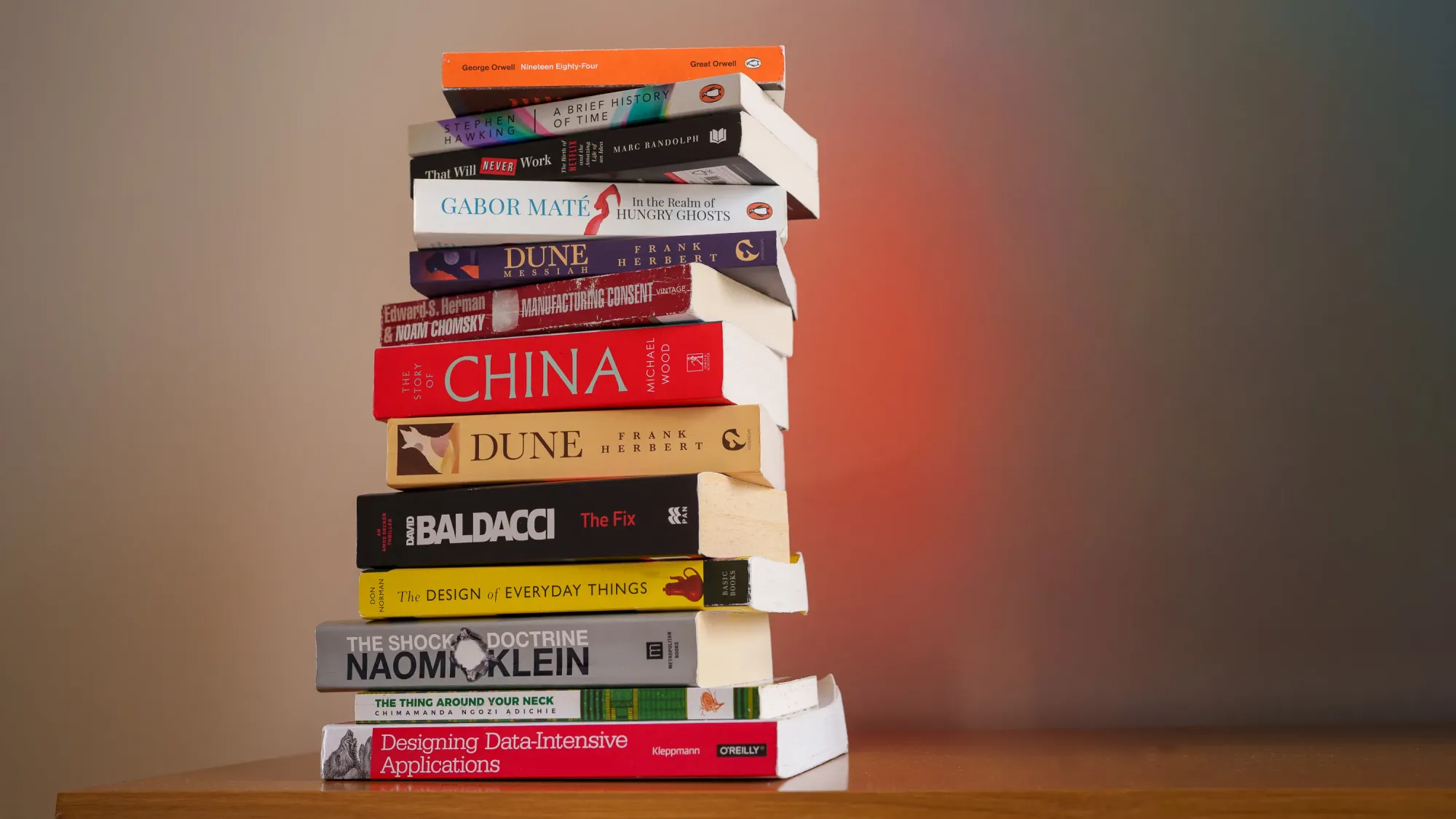
2025 was a year of intellectual discovery for me. Like the year prior, I continued my foray into understanding the past and launched fresh attempts to understand who we are as a species and the interplay between the political and economic institutions we've built. And of course, this was polka-dotted with interludes of fiction. Overall, in terms of numbers, I started reading 15 books, completed 13, and DNFed 2.
In January, I was introduced to the Orwellian world of Big Brother, an all-seeing and all-controlling enigma in George Orwell's 1984; a story of a torrid and tragic love in an authoritarian regime that keeps the citizenry docile with endless wars. The newspeak concepts of doublethink and doublespeak, a relentless rewriting of the past, and constant surveillance have helped me to understand the current state of world affairs. Although it was published in 1949, it felt like a prophecy for the current times.
Having had a second-hand experience of substance and behavioural addiction, I have wondered why we keep doing things that harm us, but feel so powerless to stop. Gabor Maté answered that in In the Realm of Hungry Ghosts, where he paints a vivid picture of the psychology of addiction, and how the seeds could be planted in utero and early life. He explained how factors like trauma and stress predispose one to addiction. All forms of addiction, Maté wrote, involve the hijacking of the brain’s natural systems for pain relief, pleasure, and motivation—the opioid and dopamine pathways.
Naomi Klein's The Shock Doctrine: The Rise of Disaster Capitalism exposed me to the wave of neoliberal fundamentalist capitalism that began in the US in the 1950s. This brand of capitalism, she writes, exploits both natural and artificial disasters to push through unpopular and sweeping economic reforms that further enrich the rich, gut public services, exploit the vulnerable and lock the working class into a vicious circle of poverty. Disaster capitalism is effective because people already shocked by disaster (war, hurricanes, economic collapse) are in no position to resist when bad actors capitalise on that initial disorientation to introduce even more destabilising and exploitive policies.
By May, I read The Thing Around Your Neck by Chimamanda Ngozi Adichie. It is a collection of six short fictional stories, one of which is eponymous with the title of the book. The stories revolve around the themes of romance, challenges faced by immigrants, and female empowerment, all of which are recurring themes in the author's oeuvre.
I subsequently started my journey into the interplanetary world created by Frank Herbert in Dune, the first in a six-book series. It's a story about a conflict between royal families. About spice—a multifunctional but scarce resource—and the oppression of the Fremen, whose home planet of Arrakis is the only source of the spice in the known universe. And about young Paul Atreides' tumultuous accession to the throne, freeing the Fremen from the shackles of the Harkonnens.
In August, I DNFed Designing Data-Intensive Applications by Martin Kleppmann. I started it back in May, but it felt too theoretical and detached. I struggled through about 45% of it before I hung up my boots. I did learn about the inner workings of some data systems, though.
Afterwards, I returned to my first love: fast-paced crime thrillers. I picked up Strictly for Cash and Mallory both by James Hadley Chase. Gritty stories of the interplay between avarice, sex and murder: the hallmark of all Chase's books.
In Manufacturing Consent: The Political Economy of the Mass Media by Edward S. Herman and Noam Chomsky, the authors posited the Propaganda model, a five-point framework which they used to explain how propaganda is disseminated in Western countries with seemingly "free and fair" media. With these filters of media ownership, advertisers, news sourcing, flak and ideology, governments and corporations "manufacture content": shape public opinion to support policies that ultimately serve the interests of the elite.
By September, I started A Brief History of Time by Stephen Hawking and even though I really liked the topic of discourse, it was so dense that while I was technically reading the words, very little sunk in. So I DNFed it. I'll probably return to it again this year, with more patience and slower reading.
Subsequently, I picked up Michael Wood’s The Story of China, where I learned about the colourful history of China from its early Bronze Age civilisation in the Yellow and Yangtze River basins to post modern period. China's history can be summed up as an undulation of dynasties and empires, with each adding a new strata to the rich Chinese culture. Natural disasters, like the flooding of the Yangtze River, and governmental decadence played vital roles in the rise and fall of dynasties: a falling dynasty is believed to have lost the Mandate of Heaven and a rising one, gained it. Following the fall of the Qing dynasty at the turn of the 20th century, there was an interlude of a republic, but this was cut short by Mao's rise, whose economic policy of rapid industrialisation ushered in deaths and famine. The author ended with a note that the meteoric rise of China in the last decades could be hampered by its authoritarian government.
The story of Netflix's early years was chronicled by its co-founder, Marc Randolph, in That Will Never Work. It highlights the precarious nature of startups: success is never certain, the original plan rarely works, and you need to keep pivoting to keep the wolf from the door.
In November, I picked up David Baldacci's The Fix. It's a bland, nondescript, run-of-the-mill FBI-themed crime thriller with just enough cliffhangers to make it a page turner. A classic story of the "righteous" FBI fighting Machiavellian Russian espionage.
My fascination with user experience spurred me to read The Design of Everyday Things by Don Norman. I learned about the gap between the interaction of humans and machines, and how that gap can be bridged through human-centred design. Norman lays out the seven stages of the human action cycle and how different parts of the brain are engaged depending on familiarity with a task. He also explores the subconscious combination of what we know and the information we glean from the environment in the performance of everyday actions. The book also touches on the iterative, user-centred nature of the Double Diamond design model, and the reality that achieving the most user-centred product is not always feasible due to constraints like cost and delivery timelines. Finally, it makes the point that merely displaying errors is not enough; they must be accompanied by a path to resolution.
I ended the year with the second book in the Dune series: Dune Messiah. In the bid to stave off an even worse outcome as foreseen in his prophecies, Paul, whose story poised so gloriously at the end of the first book, lost Chani and appeared to have ended tragically in the desolate deserts of Arrakis.
